Baseline failure · Dot IR success
Prompt probe
“Reach the second largest food item on the chopping board.”
Baseline
Failure · wrong object
Oracle dot IR
Success
Evaluating Spatial Understanding for Robotics
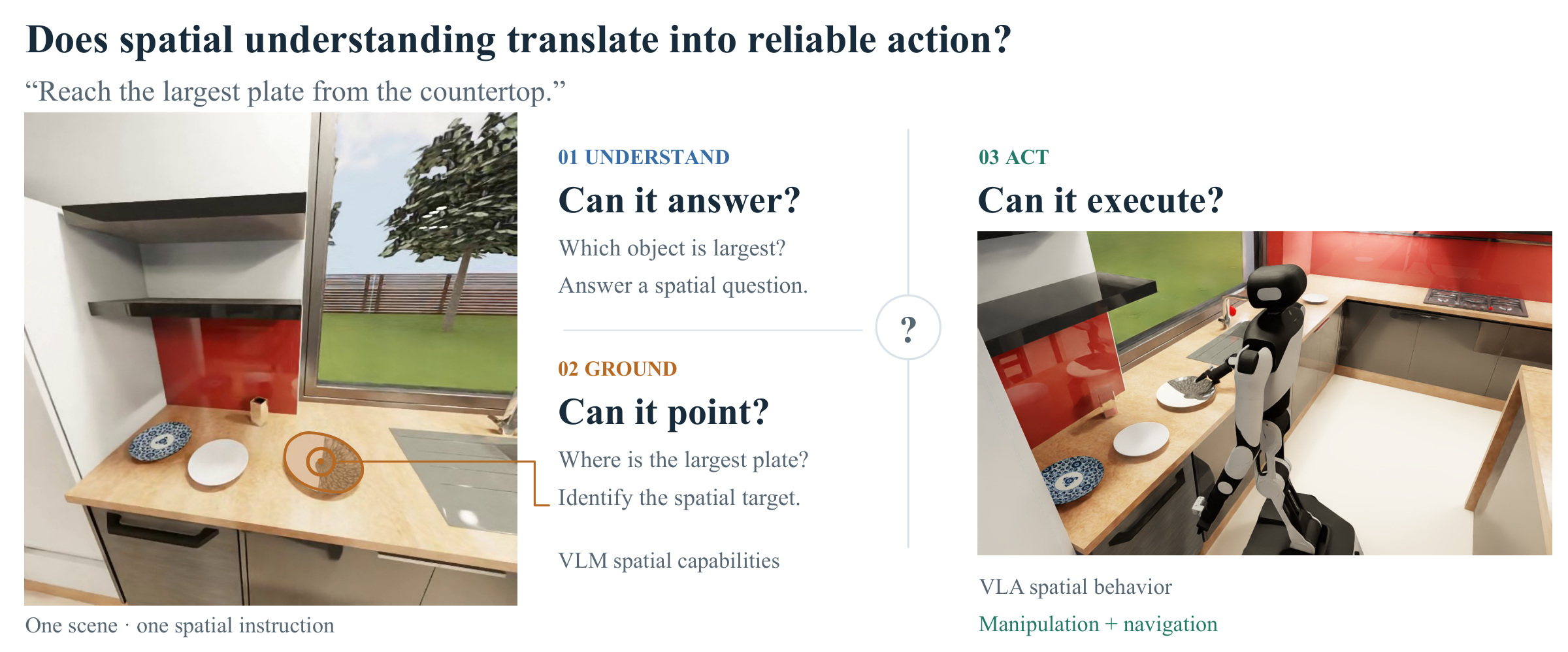
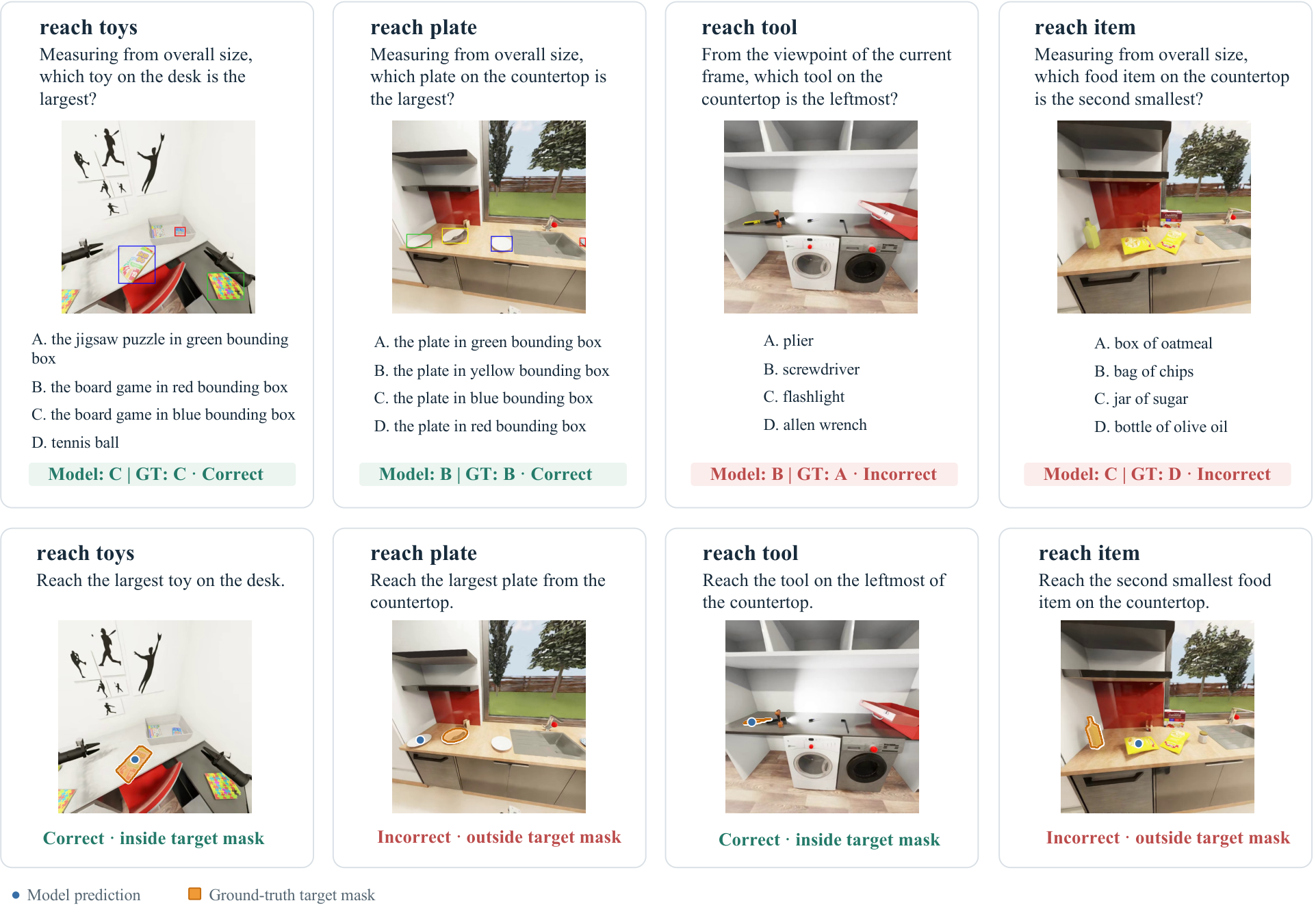
Can a model that answers a spatial question also identify the intended target and guide a robot to act on it?
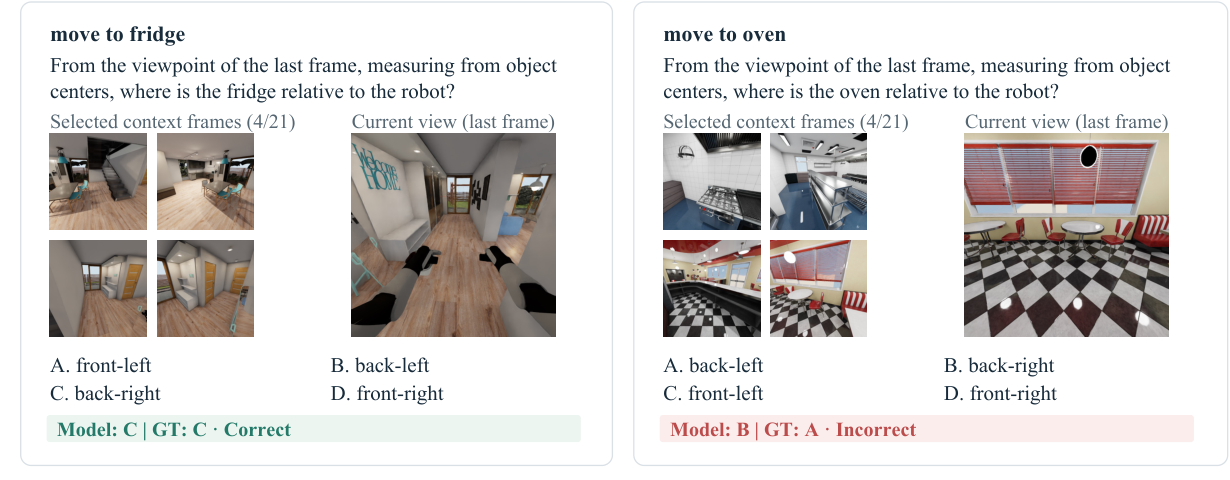
BEHAVIOR-Spatial connects these evaluations across shared scenes, objects, and spatial relations.
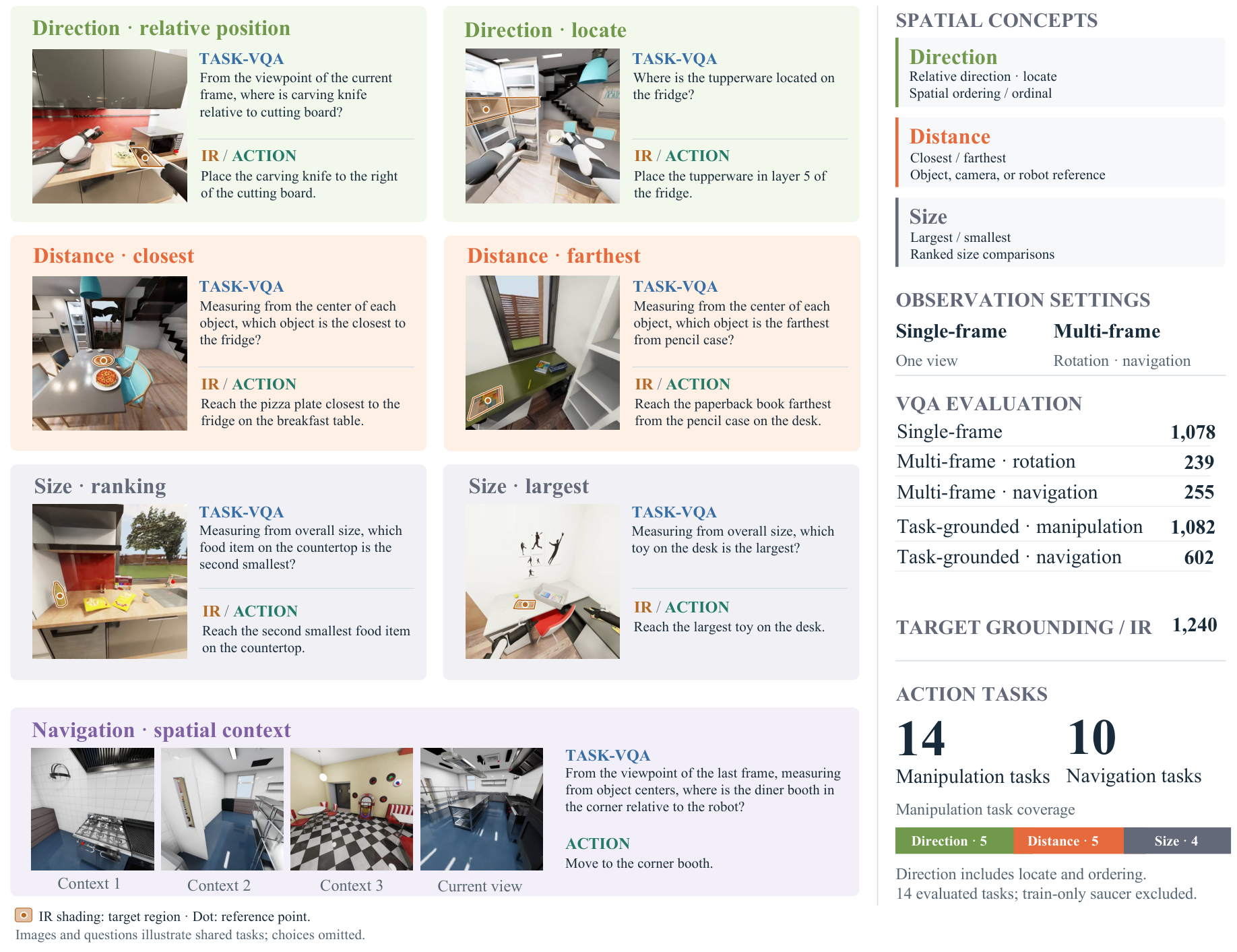
Robot tasks require grounding spatial language in physical scenes, but task success alone cannot establish whether spatial instructions are followed. We present BEHAVIOR-Spatial, a benchmark built on BEHAVIOR-1K that measures spatial question answering, point-based target grounding, and robot action to examine how VLM spatial understanding relates to VLA behavior. It comprises 3,256 spatial questions across 49 activities, 1,240 grounding queries across 14 manipulation tasks, and action evaluations covering those 14 tasks and 10 navigation tasks. Our manipulation protocol evaluates held-out configurations and instruction following when the requested target changes within a fixed training layout. The baseline achieves 41.6% on held-out configurations but only 16.1% under changed instructions. VLM adaptation and robot-data pretraining provide limited improvements, whereas oracle visual target cues raise these rates to 60.3% and 38.0%, respectively. Perception evaluations reveal policy-dependent correlations between VLM question-answering and grounding accuracy and VLA manipulation performance. Together, these findings motivate evaluating spatial instruction following alongside task completion and examining when spatial perception performance translates into robot behavior.
Understand. Ground. Act.
3,256 spatial questions across 49 activities, 1,240 grounding queries, and action evaluations covering 14 manipulation and 10 navigation tasks.
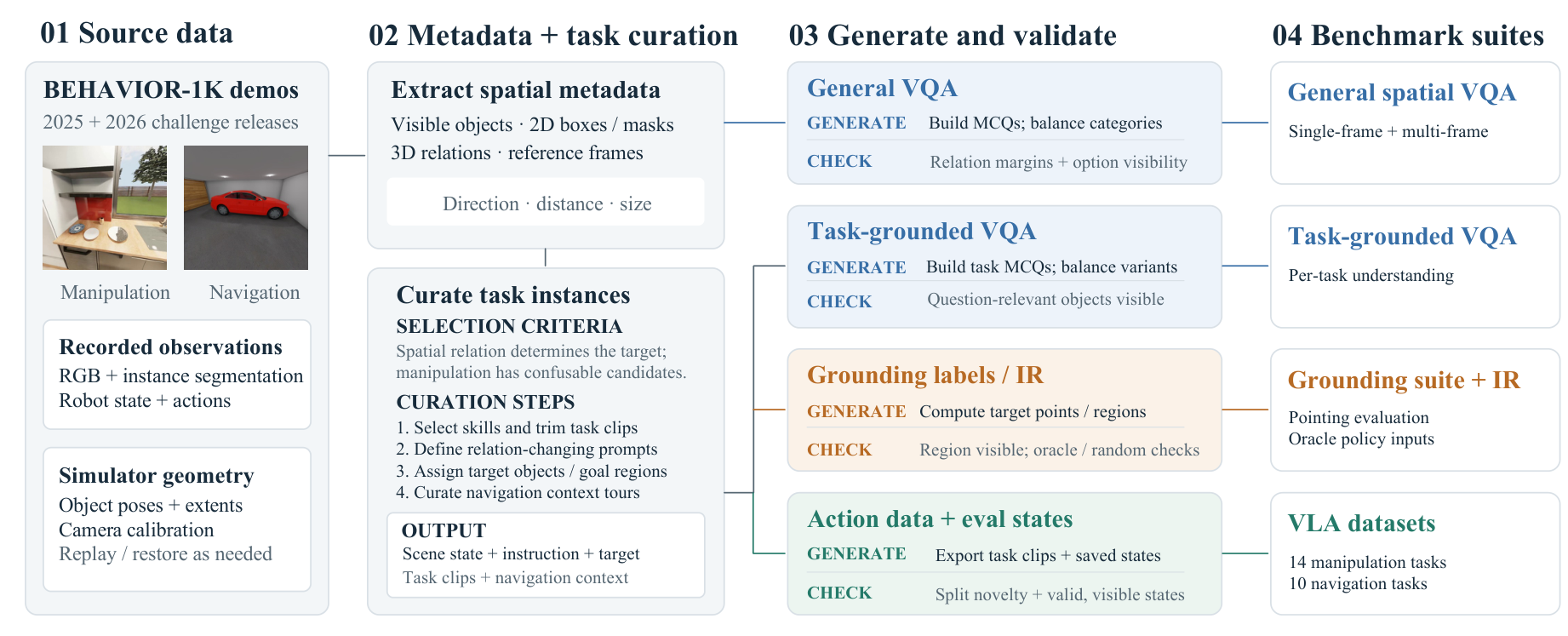
We derive the benchmark from BEHAVIOR-1K demonstrations, combining recorded observations with simulator geometry. Spatial metadata and curated task instances produce question-answering samples, grounding labels, and action datasets, with validation for each suite.
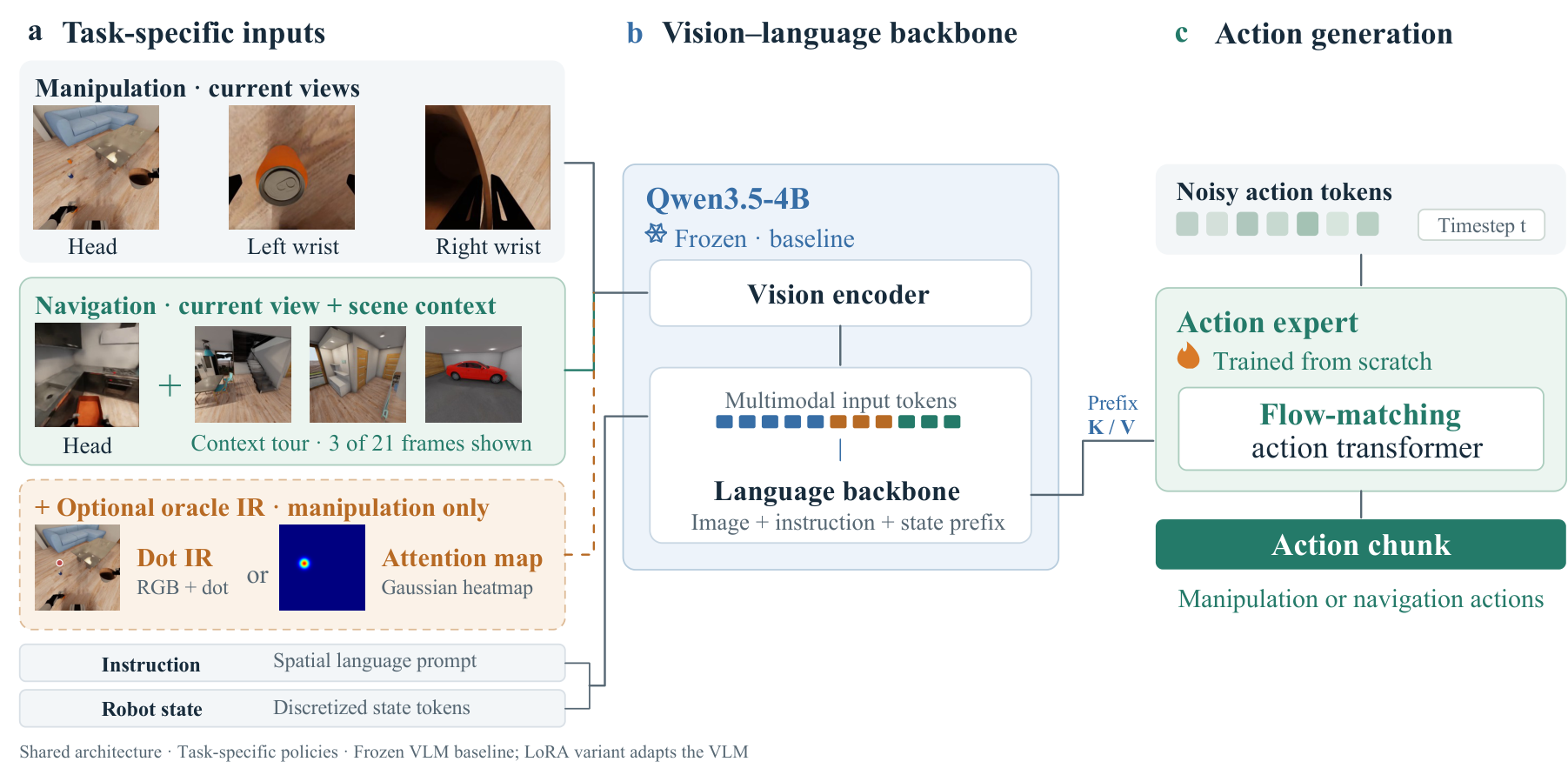
BEHAVIOR-Spatial-VLA uses task-specific camera views, a Qwen3.5-4B backbone, and a flow-matching action expert. Manipulation variants test backbone adaptation, robot-data pretraining, and oracle visual target cues; navigation incorporates scene context.
| Model | Single-frame | Multi-frame | ||||
|---|---|---|---|---|---|---|
| All ↑ | Dir. ↑ | Dist. ↑ | Size ↑ | All ↑ | Dir. ↑ | |
| Proprietary | ||||||
| GPT-6 Astra | 82.1 | 85.8 | 77.3 | 77.7 | 74.4 | 74.6 |
| Gemini 3 | 77.8 | 80.5 | 75.2 | 72.7 | 71.1 | 69.6 |
| Fable5.1 | 70.5 | 69.3 | 70.2 | 76.3 | 68.4 | 66.8 |
| GPT-5 | 64.7 | 61.7 | 68.1 | 69.1 | 63.2 | 59.6 |
| Gemini 2.5 | 59.9 | 55.0 | 65.2 | 68.3 | 60.1 | 57.4 |
| Open-weight | ||||||
| Molmo2-8B | 51.8 | 45.0 | 57.5 | 66.9 | 36.8 | 30.7 |
| Qwen3.5-9B | 50.6 | 42.0 | 58.1 | 69.1 | 54.5 | 51.4 |
| Qwen3.5-4B | 46.8 | 44.8 | 48.1 | 51.8 | 46.6 | 44.1 |
| Molmo2-4B | 45.5 | 34.2 | 58.7 | 62.6 | 32.4 | 23.7 |
| PaliGemma | 36.2 | 32.5 | 40.7 | 41.0 | 37.9 | 34.4 |
| PaliGemma 2 | 34.8 | 29.8 | 39.2 | 45.3 | 27.3 | 23.4 |
| Gemma 3-4B | 34.4 | 35.0 | 33.6 | 33.8 | 29.2 | 21.3 |
| Qwen2.5-VL | 33.4 | 31.2 | 37.8 | 32.4 | 28.9 | 22.9 |
| DeepSeek-VL2-Tiny | 31.4 | 30.5 | 34.8 | 26.6 | 25.0 | 17.6 |
| VLM backbones extracted from released VLA models | ||||||
| OpenHelix | 9.6 | 5.8 | 14.2 | 15.1 | — | — |
| π₀.₅ | 0.9 | 0.8 | 0.3 | 2.9 | — | — |
| Chance | 25.0 | 25.0 | 25.0 | 25.0 | 25.0 | 25.0 |
Direction includes locate. “All” is pooled over questions. Higher is better; bold marks the highest value in each column. A dash indicates an unreported result.
| Model | Task-grounded VQA | IR | ||||
|---|---|---|---|---|---|---|
| All ↑ | Dir. ↑ | Dist. ↑ | Size ↑ | Strict ↑ | Tolerant ↑ | |
| Qwen3.5-9B | 57.2 | 56.3 | 61.4 | 52.5 | 51.4 | 59.7 |
| Molmo2-4B | 53.0 | 54.1 | 56.4 | 46.8 | 27.1 | 40.5 |
| Molmo2-8B | 50.0 | 49.9 | 53.4 | 45.3 | 46.7 | 58.4 |
| Qwen3.5-4B | 49.4 | 50.9 | 48.6 | 48.6 | 43.3 | 56.2 |
| Gemma 3-4B | 33.5 | 23.0 | 42.4 | 36.0 | 36.8 | 47.9 |
VQA and IR are evaluated on shared manipulation task contexts. Higher is better; bold marks the highest value in each column.
| Policy | Held-out | Prompt-probe | |||
|---|---|---|---|---|---|
| +Soft ↑ | S ↑ | +Soft ↑ | S ↑ | W ↓ | |
| π₀.₅-Qwen (frozen VLM) | 41.6 | 27.9 | 16.1 | 10.0 | 70.0 |
| + LoRA-VLM | 43.5 | 30.9 | 17.9 | 9.6 | 68.1 |
| + DROID pretrain init | 40.1 | 24.7 | 16.6 | 8.9 | 66.0 |
| IR-conditioned (oracle IR) | |||||
| + dot IR | 60.3 | 44.8 | 38.0 | 24.9 | 43.9 |
| + dot IR + first-frame anchor | 59.1 | 41.8 | 36.3 | 23.7 | 42.4 |
| + attn-map IR | 59.3 | 39.0 | 35.0 | 17.0 | 46.0 |
| Data scaling · dot IR recipe | |||||
| + dot IR @ 50% data | 53.7 | 33.7 | 30.6 | 19.4 | 45.7 |
| + dot IR @ 30% data | 56.1 | 34.5 | 32.6 | 19.9 | 46.6 |
+Soft: soft success, a proxy for target-selection intention. S: strict success (task completion). W: wrong-target commitment. IR-conditioned policies receive oracle target cues. Bold marks the best value in each column.
Reading the results
Soft success is a behavioral proxy for target-selection intention. The baseline achieves 41.6% soft success on held-out configurations and 16.1% when instructions change within a fixed training layout. Oracle dot IR target cues raise these to 60.3% and 38.0%, respectively.
Strict success requires completing the instructed interaction. On the prompt probe, oracle dot IR achieves 24.9% strict success, compared with 38.0% soft success: identifying the target helps, but does not solve execution.
| Writer | +Soft ↑ | S ↑ | W ↓ |
|---|---|---|---|
| Proprietary writers | |||
| Fable 5.1 | 66.1 | 51.4 | 23.5 |
| GPT-6 | 61.2 | 47.3 | 23.0 |
| Gemini 3 | 50.3 | 33.3 | 28.8 |
| Open-weight writers | |||
| Qwen3.5-9B | 39.0 | 5.3 | 8.7 |
| Qwen3.5-4B | 37.1 | 5.1 | 7.2 |
Writers generate robot-control programs using shared perception tools and a motion API. Programs are developed on training episodes, then frozen for held-out evaluation. +Soft: soft success. S: strict success. W: wrong-target commitment. Bold marks the highest soft and strict success rates.
Baseline and oracle dot IR on the same task instances. Clips show a third-person view with a head-camera inset and play at 4× speed. Oracle dot IR supplies the instructed target as a visual mark.
Baseline failure · Dot IR success
Prompt probe
Failure · wrong object
Success
Baseline failure · Dot IR success
Held-out
Failure · wrong object
Success
Baseline failure · Dot IR success
Prompt probe
Failure · wrong object
Success
Both policies succeed
Held-out
Success
Success
Baseline failure · Dot IR success
Held-out
Failure · wrong object
Success
Baseline failure · Dot IR success
Prompt probe
Failure
Success
Baseline failure · Dot IR success
Prompt probe
Failure
Success
Baseline failure · Dot IR success
Prompt probe
Failure · wrong object
Success
Both policies succeed
Held-out
Success
Success
Both policies succeed
Held-out
Success
Success
Both policies fail
Prompt probe
Failure · wrong object
Failure · wrong object
Both policies fail
Prompt probe
Failure · wrong object
Failure · no target commitment
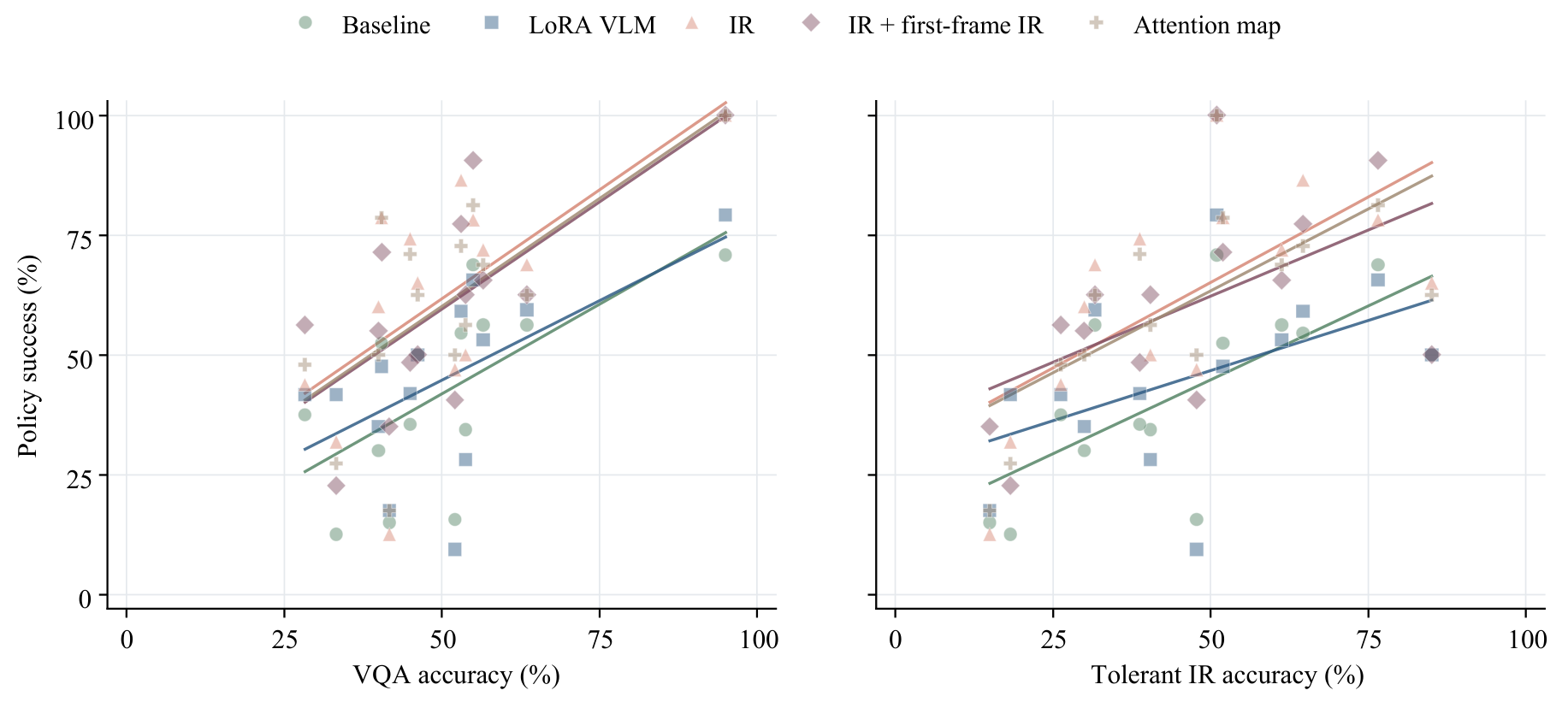
How do spatial question answering and target grounding relate to robot performance? Across the 14 manipulation tasks, the relationship between perception accuracy and policy soft success varies by policy variant.
| Policy | VQA (ρ) | IR (ρ) |
|---|---|---|
| Baseline | 0.713 | 0.658 |
| LoRA VLM | 0.616 | 0.581 |
| IR | 0.560 | 0.701 |
| IR + first-frame IR | 0.612 | 0.618 |
| Attention map | 0.608 | 0.753 |
Spearman correlations across 14 manipulation tasks between Qwen3.5-4B VQA or tolerant IR accuracy and policy held-out soft success. Ties receive average ranks.